Putting the Rice Back in Rice Festival
The Bay City Lions aren’t trying to build a new Rice Festival. In some ways, they’re trying to bring back the old one.
The Bay City Lions aren’t trying to build a new Rice Festival, but they are making significant changes.
In some ways, those changes seem to reflect the Rice Festival’s past.
Not the exact carnival rides. Not the same parade floats. And certainly not six tables stretching more than a block and enough barbecue to feed the thousands who arrived by train for Bay City’s first Rice Carnival in 1901.
No. It seems the changes are aimed at bringing back something a little harder to put on a schedule.
The community.
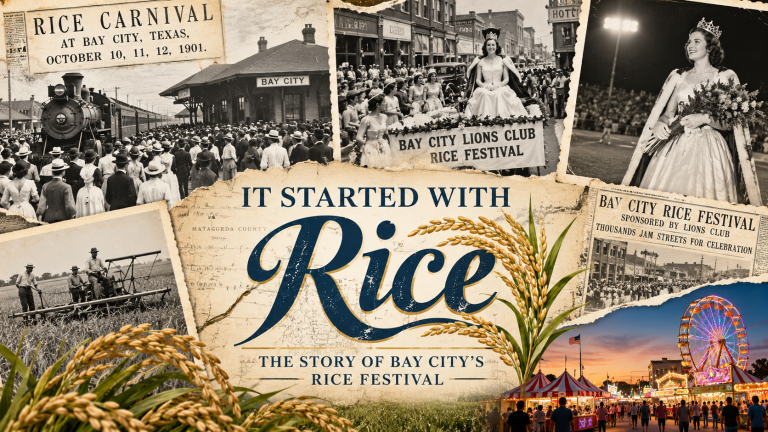
In Part 1 of our Rice Festival series, It Started With Rice, we went all the way back to 1901, when Bay City celebrated a booming new crop, a new railroad and what the Matagorda County Tribune called an “industrial awakening.”
When the Bay City Lions revived the celebration in 1941, the Rice Festival grew into something generations of local families would recognize: queens and parades; bands and Blackcat football; carnival rides; decorated storefronts; agricultural competitions; and a courthouse square packed with people.
Rice wasn’t simply in the name, and the Rice Festival wasn’t simply somewhere people went. The community helped make it happen.
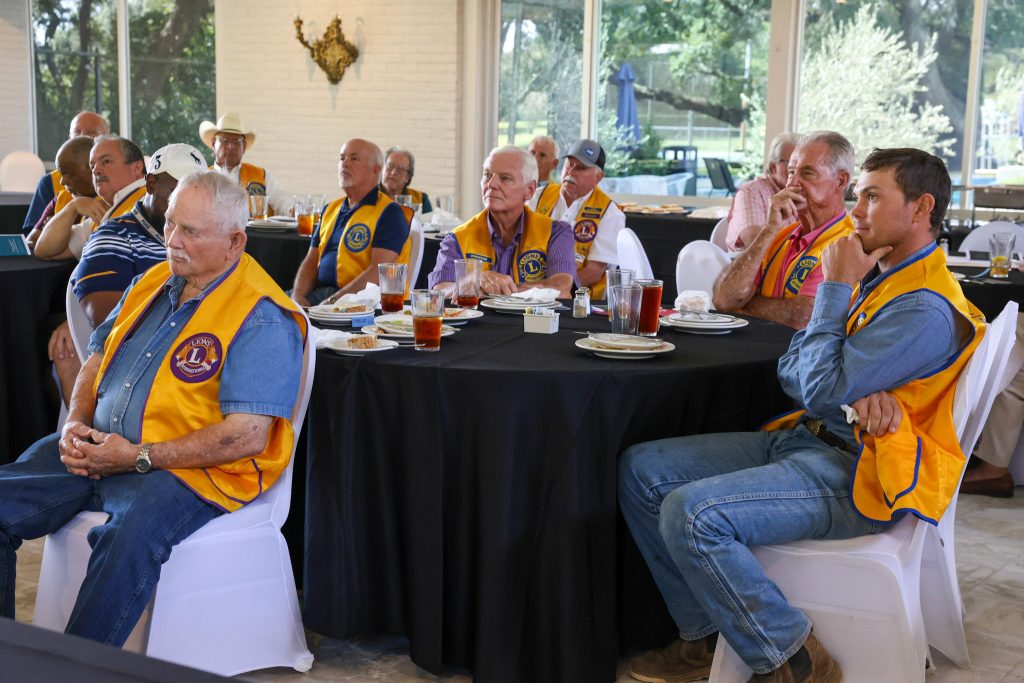
Over the decades, the festival changed. It grew beyond the courthouse square and moved much of the celebration to the Matagorda County Fairgrounds. Traditions evolved. The community changed. And the kind of participation longtime Lions remember from some of Rice Festival’s biggest years became harder to find.
This year, they’re aiming to rekindle that community relationship.
First, open the gates
The most noticeable change may also be the simplest.
Admission to the 2026 Bay City Lions Rice Festival is free. No admission charge just to walk through the gates.
For four days, the Lions want families to come to the fairgrounds, see what’s happening, visit vendors, watch an event, ride the carnival, run into neighbors, and stay awhile.
For Lions Club President Chad Craft, the change is part of a larger effort to get people engaged with the Rice Festival again.
“The last few years, we’ve seen a decline in participation and attendance,” Craft said. “In the past we’ve charged from ten dollars to five dollars for entry fees.
“Last year, we had a well-known artist come and perform, but the tickets were sixty dollars apiece. That made us start reflecting on we [the club] couldn’t afford this, and people just can’t afford to pay that much.
“It’s not the direction we wanted to continue in,” he said.
Craft continued, “It’s our 80th year and well, we figured if we want to get back to making it for our community, let’s make it free.”
Free admission isn’t the only attempt to remove a barrier.
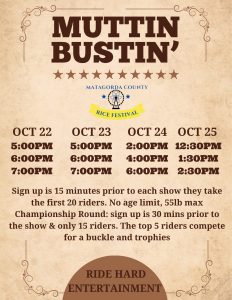
The festival’s mutton bustin’ is free for participating children, too. Safety equipment is provided, regular shows are planned throughout all four days, and the weekend will culminate with championship competition.
Around it, the Lions are building a festival that offers more than a carnival midway.
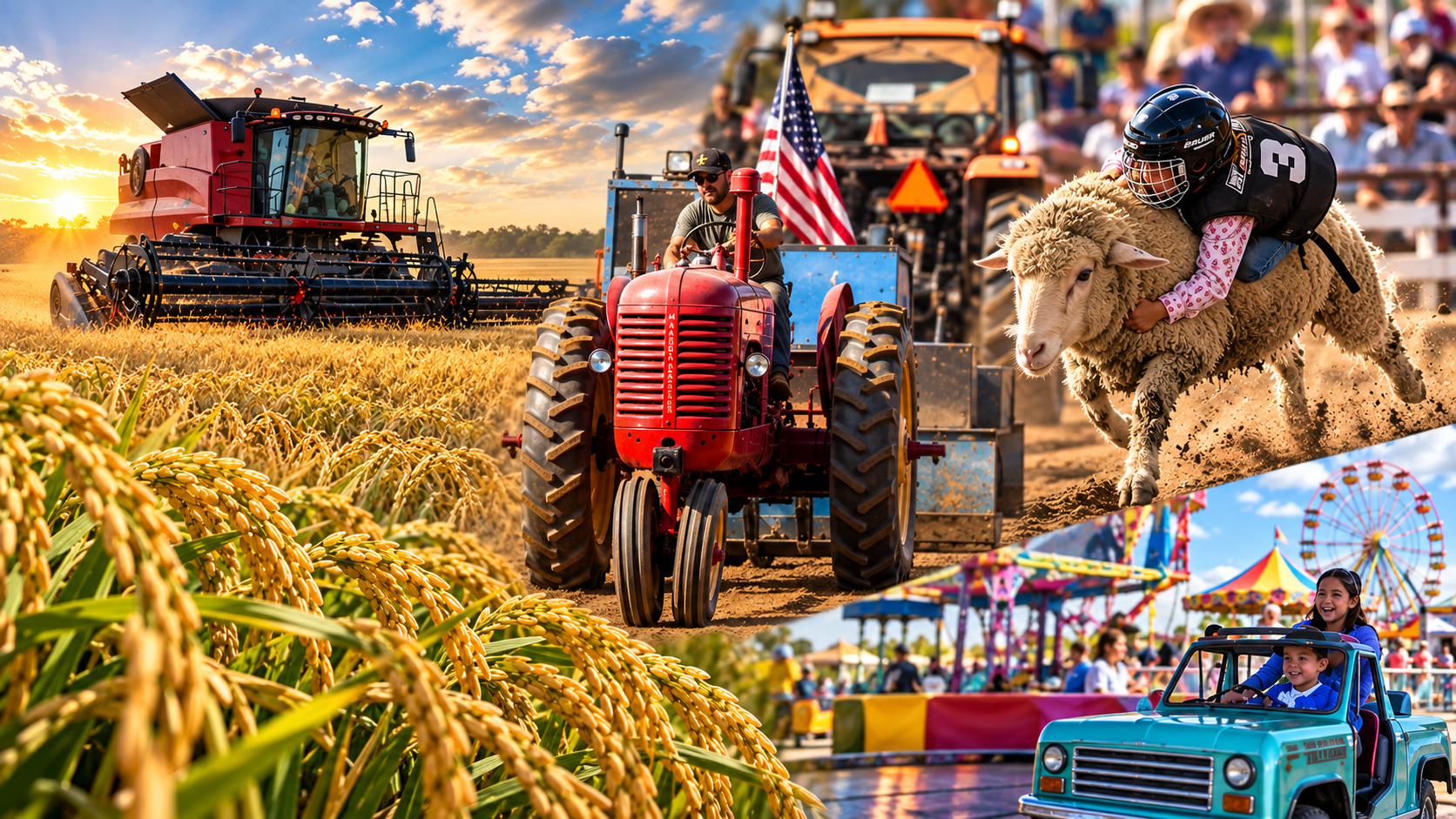
The 80th Annual Rice Festival Parade remains. So do vendors and the carnival. But the weekend also includes a car show, antique tractors, a tractor pull, robotics, bingo, magic and other entertainment.
The goal isn’t to make the Rice Festival bigger for the sake of being bigger.
It’s to give more of the community a reason to be part of it.
Putting the rice back in—literally
And then we meet Lion Coleman Franz.
Franz is organizing this year’s Antique Tractor Show and Pull, an addition that feels particularly at home after digging into the history of the Rice Festival.
Community partner Guardian Precision Services is sponsoring the event.
Because before tractors became antiques, they worked.
And in Matagorda County, much of that work was agricultural.
Franz told the Junction, “I grew up, kind of, collecting antique tractors and going to antique tractor pulls.”
He continued, “I always thought it would be pretty cool to have one of our own.”
“We always travel to go to ones,” he said. “I want to say all are within one hundred miles of Bay City and have a pretty good following.”
Franz said he talked with his uncle and fellow Lion, and they tested to see whether it would draw a crowd at last year’s festival.
“We both kind of have a passion for antique tractors,” he said. “So, I got with Uncle Mike, and we tested the waters with a little show last year.
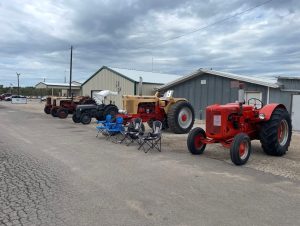
“Even though the crowds were slow, there was something there,” Franz said.
The show and pull will bring antique equipment, different weight classes and some friendly competition to the fairgrounds.
But Franz is bringing something else.
Rice and not as decoration.
Actual, locally grown rice.
Franz will be donating rice grown by his family to be given as awards to tractor show and pull contestants. And some of that rice will also be placed directly into the hands of people attending the festival.
There is something wonderfully full circle about that.
In 1901, Bay City invited thousands of people to town to celebrate a successful rice harvest and the industry beginning to transform the surrounding prairie.
More than 125 years later, a Matagorda County rice-growing family will once again send festival visitors home with rice grown here.
“I haven’t even announced it at a meeting yet,” Franz confessed. “But I’m gonna get some of my and my wife’s 2026 rice that we harvested, and we’re getting it milled and packages to give away during the festival.”

“I’m hoping to get around 200 pounds, depending on how it mills.”
He explained the thought process behind his donation.
“We were originally thinking about some sort of antique prize for contestants,” Franz said. “Everyone does the same thing with prizes at every other tractor pull, and you know, you’ll see some guy walking around with five trophies.
“Since we’re thinking about some sort of antique prize with a little more meaning behind it, we thought, well, let’s give them rice,” he said.
That’s about as literal as putting the rice back in Rice Festival gets. And perhaps that’s the point.
The Lions aren’t trying to turn back the clock to 1901—or 1956, or 1976.
They’re looking at what made those celebrations matter and asking which pieces still make sense today.
Agriculture is one of them.
The Lions can’t throw this party alone
There’s another lesson from the Rice Festival’s history that is easy to miss.
The Lions may organize it, but they never really did it alone.
Businesses once decorated their storefronts for the Rice Festival. Schools sent bands. Organizations entered floats. Farmers participated. Young people competed. Sponsors supported it. Families lined the streets.
It worked because people didn’t simply attend the festival. They participated in it.
Bay City Lion Michael Estlinbaum, who also serves as Matagorda County Precinct 2 commissioner, was the person who first nudged Matagorda Junction toward this story.
What began as a conversation about this year’s festival quickly became a much bigger question:
What happened to Rice Festival?
“We (the lions club) work for months and then all day long during the week of the festival,” Estlinbaum said, “Our moto is ‘We Serve’ so it fits, however, we want to make sure that our servitude builds the most important revenue there is – community.”
That question is what sent us digging.
It led us to the 1901 Rice Carnival. To the arrival of the railroad. To the Lions’ revival in 1941. To Rice Festival Queens under Friday night stadium lights. To downtown businesses decorating their windows, children riding the Lions’ miniature train and 83 organizations entering a single Rice Festival parade.
It also made something clear.
There wasn’t one attraction responsible for making the festival feel big.
Everybody was in on it.
“We want the community to come out, and we want to put on a show for them,” Estlinbaum said. “I want to see the faces that make up the community, whether businesses coming to sponsor, kids running to the carnival, or people sitting down to bingo, we want everyone to experience the festival.”
That may be the harder piece to recreate.
The Lions can waive admission.
They can book entertainment.
They can organize a parade, bring in tractors, host a car show, and give kids the opportunity to climb onto a sheep and hang on for dear life.
But they can’t manufacture community participation.
That part requires us.
More than something to do
For Craft and the Lions, that means giving different people different reasons to come.
Maybe you’re there because your child wants to try mutton bustin’.
Maybe antique tractors are your thing. Maybe it’s cars.
Maybe it’s the parade you’ve watched since you were a kid.
Maybe you want to play bingo, take the kids to the carnival, watch a robotics demonstration or simply wander around and see who you run into.
And maybe you’ve never been to the Rice Festival at all.
When asked Craft if there was one day that he recommends families to attend, what day would it he select?
“Saturday,” he said. “We start off with the parade that goes around the square at 10:00 am. Then, at 12 o’clock, we open the gates and that’s when all the fun stuff starts.”
Craft continued, “Every event is going on on October 24. There is something for literally everyone.”
The Lions president even expressed his personal excitement for the mutton bustin’.
“It’s just wild and fun to watch kids as young as two-years-old ride on sheep,” Craft said. “I know it sounds crazy, Babies on the back of sheep, but the event organizer makes it so cool, and it is a SHOW.”
There is another side to the festival that matters, too.
The Lions Club’s work doesn’t end when the carnival packs up.
For example, this year’s Rice Festival Car Show is being promoted specifically as an event that benefits youth in the community. That service component is part of the reason Lions Clubs exist in the first place, and part of what community support for Rice Festival ultimately supports.
The Lions are hoping businesses see an opportunity here as well.
Not simply an opportunity to put a logo on something, but to help rebuild an event that belongs to the community in which they operate.
Vendor spaces, parade entries, sponsorship opportunities and other ways to participate are still available through the Bay City Lions Club and all of the local, supporting clubs.
Because if we’re going to borrow one lesson from the people who threw Bay City’s first Rice Carnival 125 years ago, perhaps it should be this:
Don’t just invite people to the party. Give them a reason to help throw it.
Rice Festival isn’t going backward
There’s an important distinction in all of this.
The goal isn’t to recreate a festival that existed 50 or 75 years ago.
Bay City isn’t the same community it was then. Neither is Matagorda County. Neither is agriculture.
Families spend their time differently. Businesses reach customers differently. Entertainment has changed. And today’s Rice Festival competes for people’s attention in a way the Lions of 1941 couldn’t possibly have imagined.
So, this isn’t about going backward.
It’s about remembering what worked: Community; Participation; Local agriculture; Families; Businesses; Service; And, yes…Rice.
The Lions have made their changes.
Franz is bringing the tractors—and the rice.
Local businesses and sponsors are stepping up.
Now there’s one piece left. Us.
See you at the fairgrounds.
The 2026 Bay City Lions Rice Festival runs October 22–25 at the Matagorda County Fairgrounds. Admission is free.
And we’ve intentionally left quite a bit out of this story.
Because now that we’ve told you why Rice Festival is changing, there’s only one thing left to do: Figure out exactly what you’re doing when you get there.
Check back for Part 3 of our Rice Festival series, when Matagorda Junction breaks down the full four-day schedule, what you won’t want to miss, what the kids can do, when to be where, and how to make the most of Rice Festival weekend.
Because after spending two stories telling you how Bay City came to throw this party… we’d hate for you to miss it.