
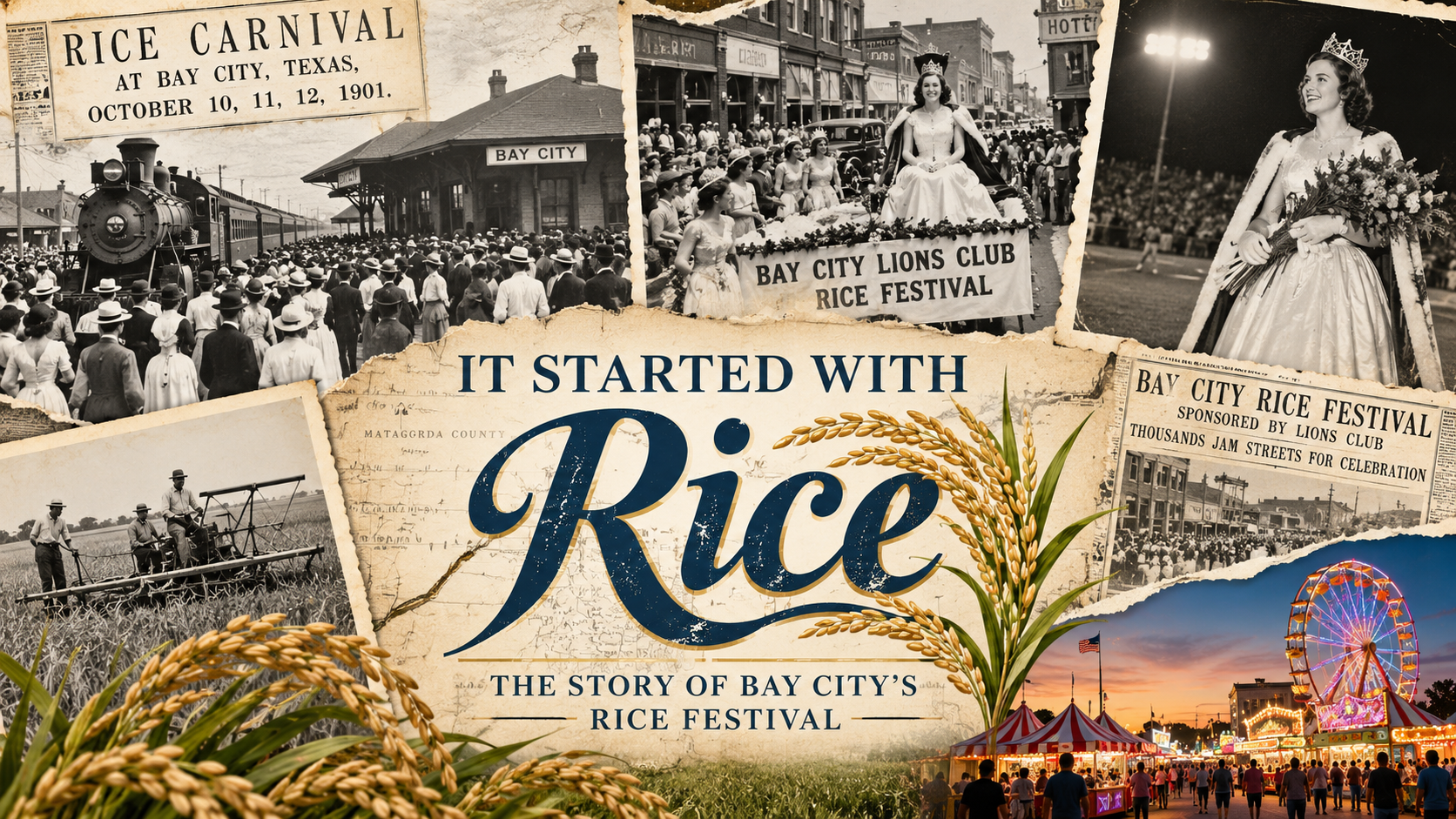
IT STARTED WITH RICE
Before the queen, the parade, and the carnival, bay city threw a party for a crop that was changing everything about its town and its tradition.
For weeks, the photographs appeared in store windows around the square.
Banners fluttered above downtown streets. The courthouse lawn became a carnival. Children waited for rides on the Lions’ miniature train while businesses decorated their windows in rice themes.
Friday night belonged to the Blackcats, but even football became part of Rice Festival. At halftime, a new Rice Festival Queen was crowned before the crowd.
And Saturday morning, Bay City gathered downtown for the parade.
This wasn’t simply an event people drove to.
For a weekend, Rice Festival was Bay City, but even that wasn’t the beginning.
To find that, you have to go back another 55 years—to a young town of fewer than one thousand people, a new railroad, a booming crop, and one enormous party.
The Day Bay City Opened Its Gates
A CELEBRATION OF A CHANGING COUNTY.
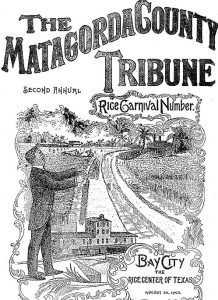
The Matagorda County Tribune devoted a special edition to Bay City’s Second Annual Rice Carnival in August 1902. Its artwork captured the forces transforming Matagorda County at the time: rice cultivation; irrigation; and the railroad.
Before there was a Rice Festival Queen, before the carnival midway, before generations of families lined the streets for the parade, there was a barbecue.
A very, very large barbecue.
On August 28, 1901, Bay City was barely six years old. Fewer than one thousand people called the young town home. But something was happening across the prairie surrounding it.
Rice was growing.
Just two years earlier, A. P. Borden began breaking ground a few miles outside Bay City for one of Matagorda County’s first commercial attempts at growing the crop. By 1901, successful harvests were beginning to turn heads— and land once thought useful primarily for grazing cattle was suddenly being viewed very differently.
Then came the railroad.
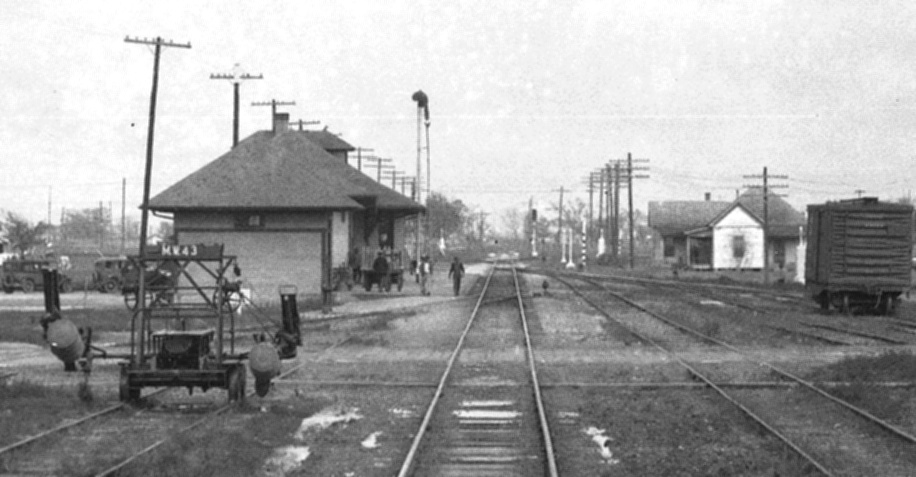
That summer, the Cane Belt Railroad completed its line into Bay City, connecting the young county seat and its developing rice industry with the world beyond it.
Bay City had two reasons to celebrate.
So, it invited everyone over and called it the Rice Carnival.
THE VIEW ON THE WAY TO THE PARTY
Days before Bay City’s first Rice Carnival, a Texas newspaper described Cane Belt passengers traveling through thousands of acres of rice fields on their way toward Bay City.
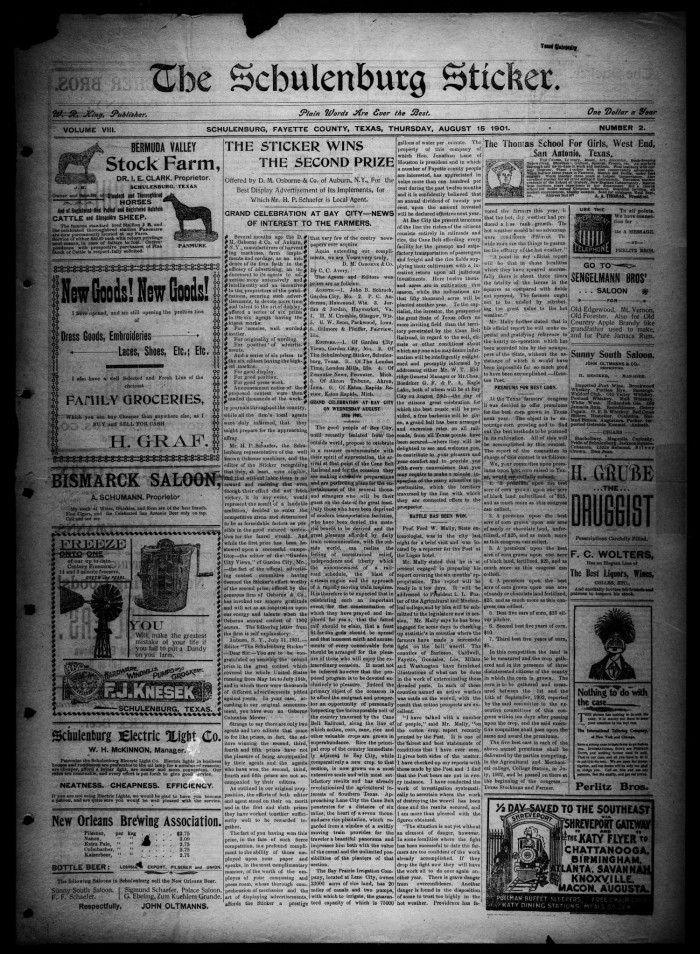
Invitations went far and wide, and special excursion trains carried visitors into town throughout the day. By the time the celebration was underway, more than five thousand people descended to the community.
Bay City was ready for them.
Near the railroad tracks, beside a massive rice warehouse still under construction, six tables were arranged beneath the Texas Gulf sky. Each stretched more than a block and was covered in white cotton cloth.
Then there was the food. Barbecued in enormous hand-dug pits, the menu held thirty cattle, twenty sheep, and twelve hogs.
Bands filled the air with music. Speakers entertained the crowd during the afternoon. Food and drink flowed freely. The Matagorda County Tribune would later report a “spirit of abandon” overtook the celebration and that “Conventionality was thrown to the winds.”
And Bay City still wasn’t finished.
As evening arrived, the crowd moved into the enormous new rice warehouse beside the tracks.
There, they danced and danced.
The Tribune, with considerably more elegance, reported, “Terpsichore held sway throughout the night.”
Eventually, the trains carried the visitors home.
But something happened that day that was larger than the barbecue, a dance, or even a successful rice harvest.
A town of fewer than one thousand people had opened its gates to more than five thousand.
The Tribune called the Rice Carnival the “crowning event of two years industrial awakening in the Colorado Valley.”
And perhaps that is the best explanation of what Rice Festival was at its beginning.
It wasn’t created simply to give Bay City something to do.
It was a celebration of what people believed this place could become.
Rice was transforming the prairie. A railroad connected Bay City to new markets. Mills, warehouses, and businesses were appearing. And the people living here believed their little six-year-old town had a future worth celebrating.
They were right. More than 125 years later, Bay City is still throwing the party.
THE LIONS BRING IT BACK
Bay City grew. The rice industry grew with it. The little town that welcomed thousands from the excursion trains of 1901 was no longer quite so little.
But the Rice Carnival was becoming a memory.
Then, in 1941, the Bay City Lions Club decided to bring it back.

They didn’t simply dust off the old name.
They called their new celebration the Bay City Rice Festival. And they went big.
The Lions planned the festival as a celebration of the rice harvest and began spreading the word well beyond Bay City. One Lions Club member even mailed small packages of rice to friends elsewhere in Texas to advertise the event.
“You see, this part of the country is essentially a rice-growing belt,” he explained in a letter published before the festival, “and the Lions club, of which I am a member, is advertising the fact that we are a rice county.”
The club was practicing what it preached.
At one Lions luncheon leading up to the festival, members were served a meal in which the foods contained rice, even the drink.
The message was clear: Rice Festival was going to be about rice.
By Oct. 2, 1941, nine days before the celebration, the plans were taking shape.
Thirty-two exhibitors reserved booths. Three rice mills planned displays of their products. More than half of the exhibitors that signed on were national organizations.
The booths would line Ave G on the east side of the courthouse square, between Sixth and Seventh streets.
And then there were the bands. Organizers expected fourteen of them.
The Lions were building more than a fundraiser. They were building a spectacle.
On Saturday, October 11, 1941, Bay City found out whether people would once again support the rice-bragging affair.
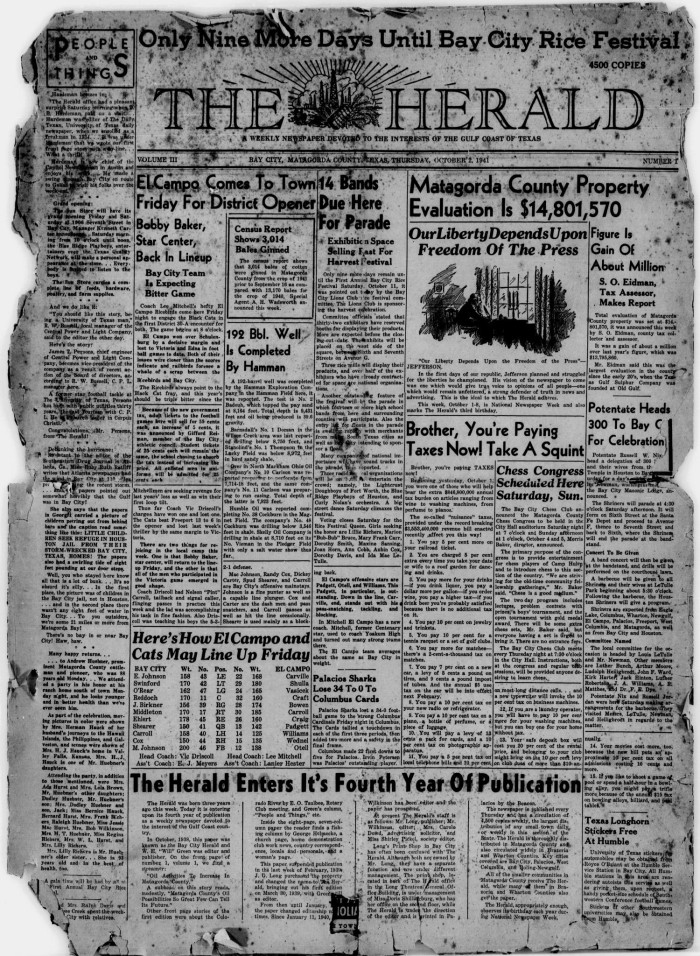
They did. In drones of thousands, people packed the streets.
There was no reliable way to count the crowd, the local newspaper reported, but the streets of Bay City were jammed with people for what was officially called the First Annual Bay City Rice Festival.
A parade rolled through town with colorful marching bands, floats, and young women riding above the crowd.
And among them was a new tradition. Her name was Aubin Cox.
Ten young women had competed for the title, but Cox became Bay City’s first Rice Festival Queen. She rode the Lions Club float accompanied by her ladies-in-waiting, beginning a tradition that would become one of the most recognizable pieces of Rice Festival history.
The response afterward was glowing.
One contemporary account praised the Lions for the planning and work required to pull it off, but its explanation of why the festival mattered sounds remarkably familiar more than eight decades later.
The celebration, it said, added to “our community life and pride in community achievement.”
It generated goodwill.
It advertised Matagorda County.
And the writer encouraged the county’s civic organizations to throw their support behind future festivals.
There would be a future. Just not yet.
Less than two months after Bay City celebrated its new Rice Festival, the Japanese attack on Pearl Harbor brought the United States into World War II.
The world changed. And once again, the Rice Festival stopped.
There would be no Rice Festival Queen in 1942. Nor 1943, 1944, nor 1945.
For four years, the festival waited.
And in 1946, post-war and post-festival slumber, the Lions awoke the Rice Festival.
Barbara Morrow of Victoria was crowned Rice Festival Queen that year, beginning the postwar chapter of a tradition that would become firmly woven into Bay City life.
By the following year, the Lions weren’t merely organizing the Rice Festival.
They were documenting why it mattered.
That year, the Bay City Lions Club published a booklet titled Historic Matagorda County: In the Heart of the Rich Gulf Coast.
Its foreword explained 1947 marked both the third anniversary of the revived Rice Festival and the 47th year of rice harvesting in Matagorda County.
The two milestones were deliberately celebrated together.
That small booklet tells us something important about what the Lions believed they were preserving.
The Rice Festival wasn’t simply a carnival with the name of a crop attached to it.
It was a celebration of the industry, people, and place that shaped Matagorda County.
And this time, the tradition would stick.
A TRADITION TAKES SHAPE
Once the Lions brought Rice Festival back after World War II, the celebration began growing into something generations of Bay City families would recognize.
The Queen competition became a centerpiece. Parades filled downtown streets. Businesses decorated their storefronts. Bands came to town. Carnival rides appeared around the courthouse square.
And before long, even Friday night football belonged to the festival.
By 1956, the festival stretched across an entire weekend.
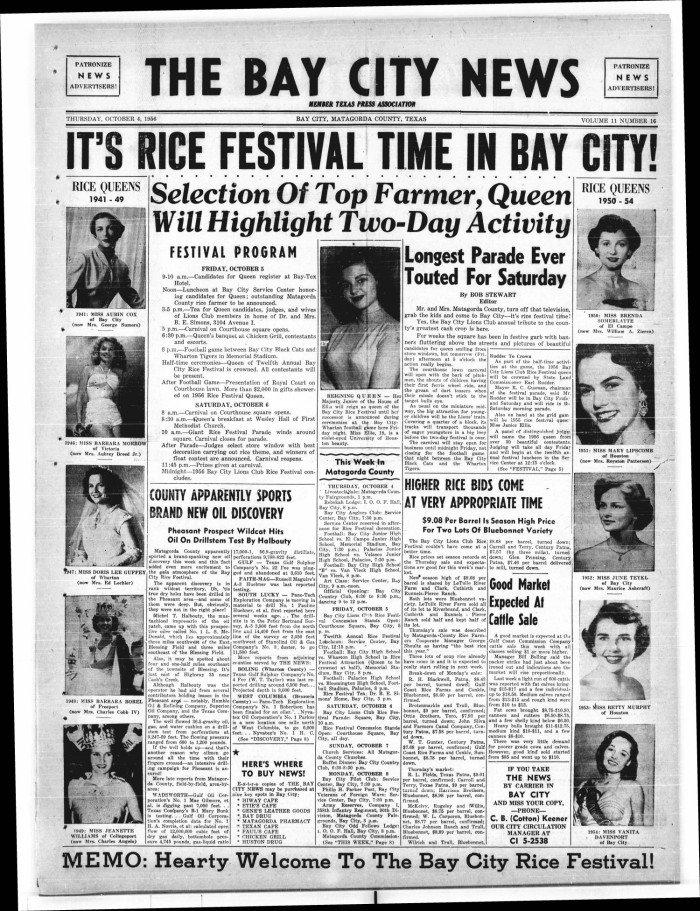
Friday brought a luncheon honoring an outstanding Matagorda County rice farmer, followed by the Queen’s tea and banquet. That evening, the Bay City Blackcats took the field, and at halftime, the new Rice Festival Queen was crowned beneath the stadium lights.
After the game, her royal court was presented on the courthouse lawn.
Saturday morning, the city woke up to a parade.
And it wasn’t a small one.
Eighty-three organizations entered the 1956 Rice Festival parade, while businesses around town competed for the best decorated storefront. The carnival continued around the courthouse square, and the Lions even operated a miniature train for children.
For a weekend, seemingly every piece of community life found its way into the Rice Festival.
And rice was more than a part of its name.
The festival continued celebrating the industry that inspired the original Rice Carnival.
Rice farmers were celebrated. Storefronts carried rice-themed displays. Agricultural organizations heavily participated.
By the 1970s, young people were getting involved too.
A 1976 Rice Festival competition challenged FFA and 4-H members to identify rice varieties, harmful weeds, diseases, and insects associated with the crop. The contest was developed with the Matagorda County Extension agent and the Beaumont Experiment Station.
They introduced the Rice Dish Roundup— a tradition that would survive through generations.
The Rice Festival wasn’t simply happening in a rice-growing county. Rice was the true orchestrator of the affair.
Not every year went according to plan.
In September 1961, Hurricane Carla slammed into the Texas coast.
That year’s Rice Festival was canceled, leaving 1960 Queen Connie Cole to carry the crown for another year.
As it always seemed to do, the festival returned.
And as the years passed, what began as a downtown celebration continued to grow.
The Queen. The parade. The Blackcats. The carnival. The courthouse square. The bands. The rice competitions. The decorated businesses.
One tradition layered itself on top of another until the Rice Festival became less an event on Bay City’s calendar and more a piece of Bay City’s identity.
Eventually; however, it would grow beyond the place where the Lions had first revived it.
FROM THEN TO NOW
The Rice Festival grew beyond the courthouse square and eventually moved much of the celebration to the Matagorda County Fairgrounds. Traditions would come and go. Generations of Lions would take their turn planning it. Crowds would change, and so would the community around it.
But more than a century after Bay City welcomed thousands to celebrate rice and a new railroad, and more than 80 years after the Lions brought that celebration back—the Rice Festival is still here.
And this year, it’s changing again.
The Bay City Lions have been reflecting on its history to plan what’s next: bringing more of the community back into the celebration; reconnecting the Rice Festival with the agricultural heritage that gave it its name; and rethinking some of the things that may have kept families away.
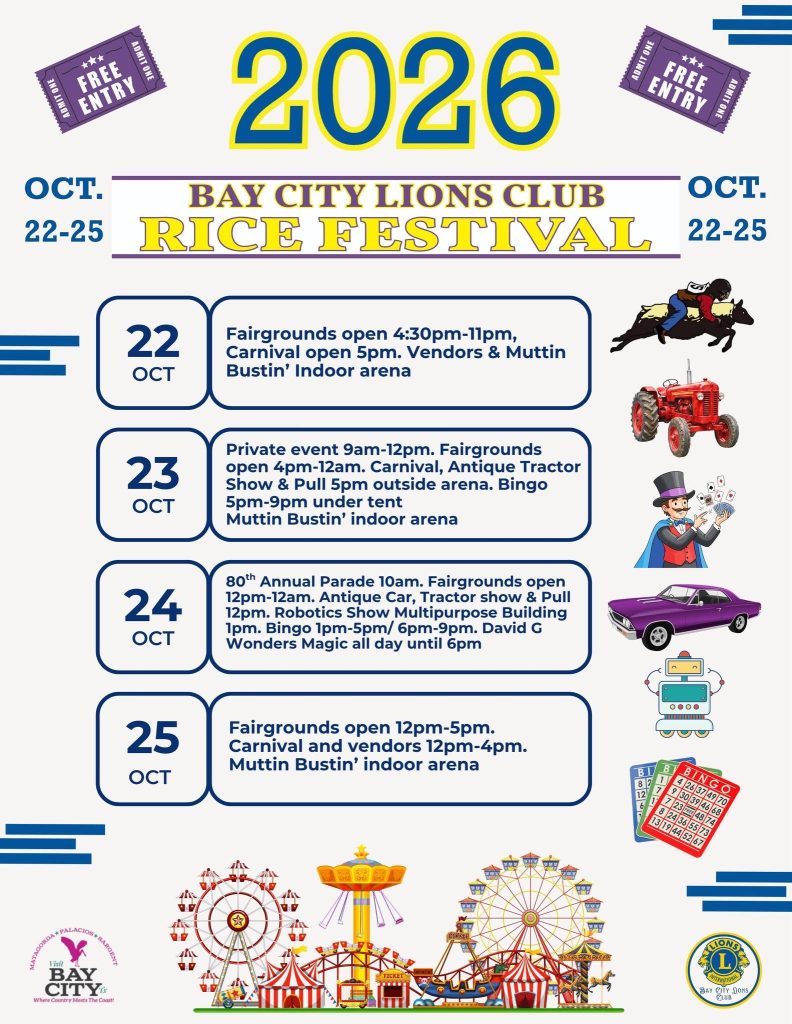
Admission to the 2026 Bay City Lions Rice Festival is FREE.
Not discounted. Not free for a few hours. Free admission to the festival.
THERE’S STILL TIME TO HELP THROW THE PARTY
The Rice Festival has always been bigger than the Lions Club.
From the businesses that once decorated their storefronts to the farmers, organizations, and families that filled Bay City’s streets, this celebration was built by a community that showed up.
And there’s still time to be part of this year’s campaign.
Businesses, organizations, and individuals can still get involved through vendor spaces, parade entries, sponsorships and more.
Get involved by visiting the Bay City Lions Club’s website.
Because if Bay City is going to throw a party more than 125 years after that first Rice Carnival, we might as well help make it a good one.
The 2026 Bay City Lions Rice Festival is Oct. 22–25 at the Matagorda County Fairgrounds, with FREE admission.
And we’re only giving you that much for now.
Check back with Matagorda Junction for Part 2: Putting the Rice Back in Rice Festival. We’ll introduce you to the Lions behind this year’s celebration, show you what’s changing, what’s coming back, and why 2026 may look a little different from the Rice Festival you remember.
WANT TO SEE MORE?
More than a century of Rice Festival history can’t fit into one story, and thankfully, much of it has been preserved.
A historical Rice Festival presentation includes photographs from the earliest Rice Carnival years, generations of Rice Festival Queens, parades and celebrations that helped shape the tradition Bay City knows today.
View the historical Rice Festival presentation:
And if these photographs leave you wanting to see more, make a visit to the Matagorda County Museum. Its collection preserves photographs, documents and pieces of Matagorda County history that simply can’t be experienced the same way through a screen.
The story of the Rice Festival is only one chapter of a much larger story, and much of it is waiting right here at home.
About this story: Historical information for this article was compiled from contemporary newspaper coverage, archived editions of the Matagorda County Tribune and other regional newspapers, historical publications, Rice Festival materials and local archival collections. Where later historical accounts differed, contemporary records were given preference.